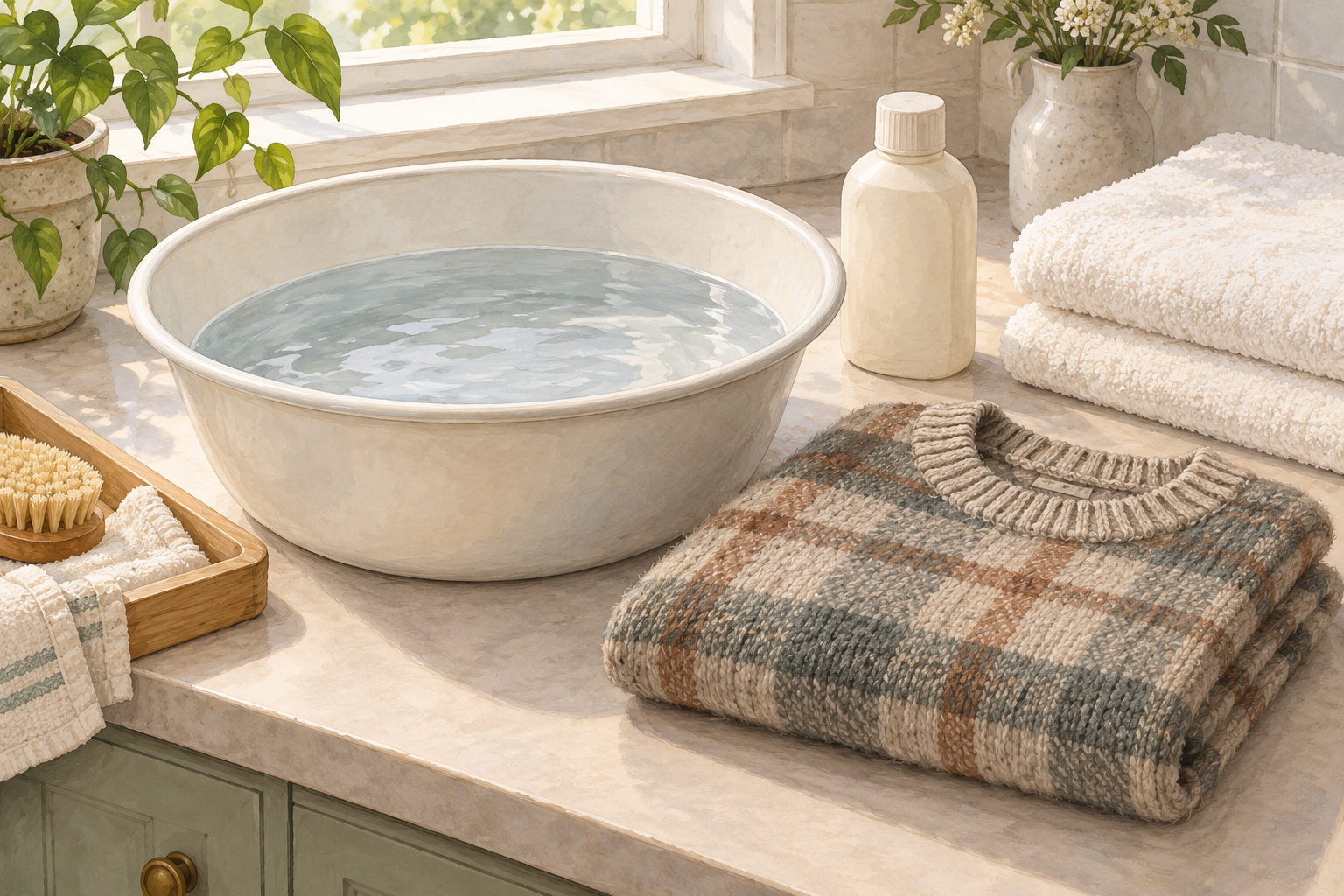
Hand-wash a wool sweater only when its care label permits it: use a mild wool detergent and lukewarm water, handle it gently, rinse, press out moisture without twisting, and reshape it to dry flat. A cozy sweater is worth a little patience; vigorous scrubbing and hanging a wet knit can turn a small laundry job into a disappointing fit.
Plan for about 20 minutes of active work, plus a 10-minute soak and drying time. Drying may take a day or longer depending on thickness and room conditions. This guide is for washable wool sweaters, not garments marked dry-clean-only, and the garment label takes priority.
Hero image: AI-generated illustration of sweater-care supplies, not a product photograph or a hands-on test.
What you need
- Wool sweater with a label permitting hand washing
- Clean basin or sink and lukewarm water
- Mild detergent labelled suitable for wool; use its stated dose
- Two clean pale, lint-free towels
- Flat drying surface or rack away from direct heat
Steps
-
Check the label before filling the basin
Look for a hand-wash instruction and the stated temperature. If it says dry-clean-only or do not wash, stop and use a professional cleaner. A plaid pattern does not tell you the fibre or permitted wash method: this guide applies only to wool garments whose labels allow hand washing.
Check for loose seams and difficult stains before you start. Blot a fresh spill rather than rubbing it; do not experiment with bleach or a strong stain remover. Turn the sweater inside out.
-
Mix a gentle wash bath
Clean the basin so no household cleaner remains. Fill it with enough lukewarm water to cover the sweater, around 30°C/86°F unless the care label requires cooler water. Dissolve the detergent before adding the knit.
Choose a mild wool wash and follow its dose for the water volume. Do not substitute heavy-duty or enzyme-containing detergent, chlorine bleach or oxygen bleach. More detergent is not better: it can mean extra rinsing.
-
Submerge gently and soak
Lower the sweater into the water and gently press it under the surface. Let it soak for about 10 minutes, unless its label gives a different instruction. Move it gently rather than scrubbing, stretching or repeatedly churning it.
Keep this a one-sweater wash so you can support the whole garment easily and avoid mixing colours. Do not leave it soaking indefinitely while you tackle other chores.
-
Rinse without pulling the wet knit
Drain the wash water while keeping the sweater supported in the basin. Rinse thoroughly with clean lukewarm water, then cold water, following Woolmark’s hand-washing guidance and any more specific garment directions.
Gently press rather than twist to move water through the fabric. If it still feels soapy, repeat with clean water. Support the body and sleeves together when lifting; do not lift the entire wet weight by its shoulders.
-
Use a towel to absorb extra water
Lay the sweater flat on a clean, dry towel. Roll the towel and sweater together loosely, then press the roll gently so the towel absorbs water. Do not wring or twist it.
Unroll promptly and move the sweater, fully supported, to a fresh dry towel. The aim is to remove dripping water, not to squeeze the knit completely dry.
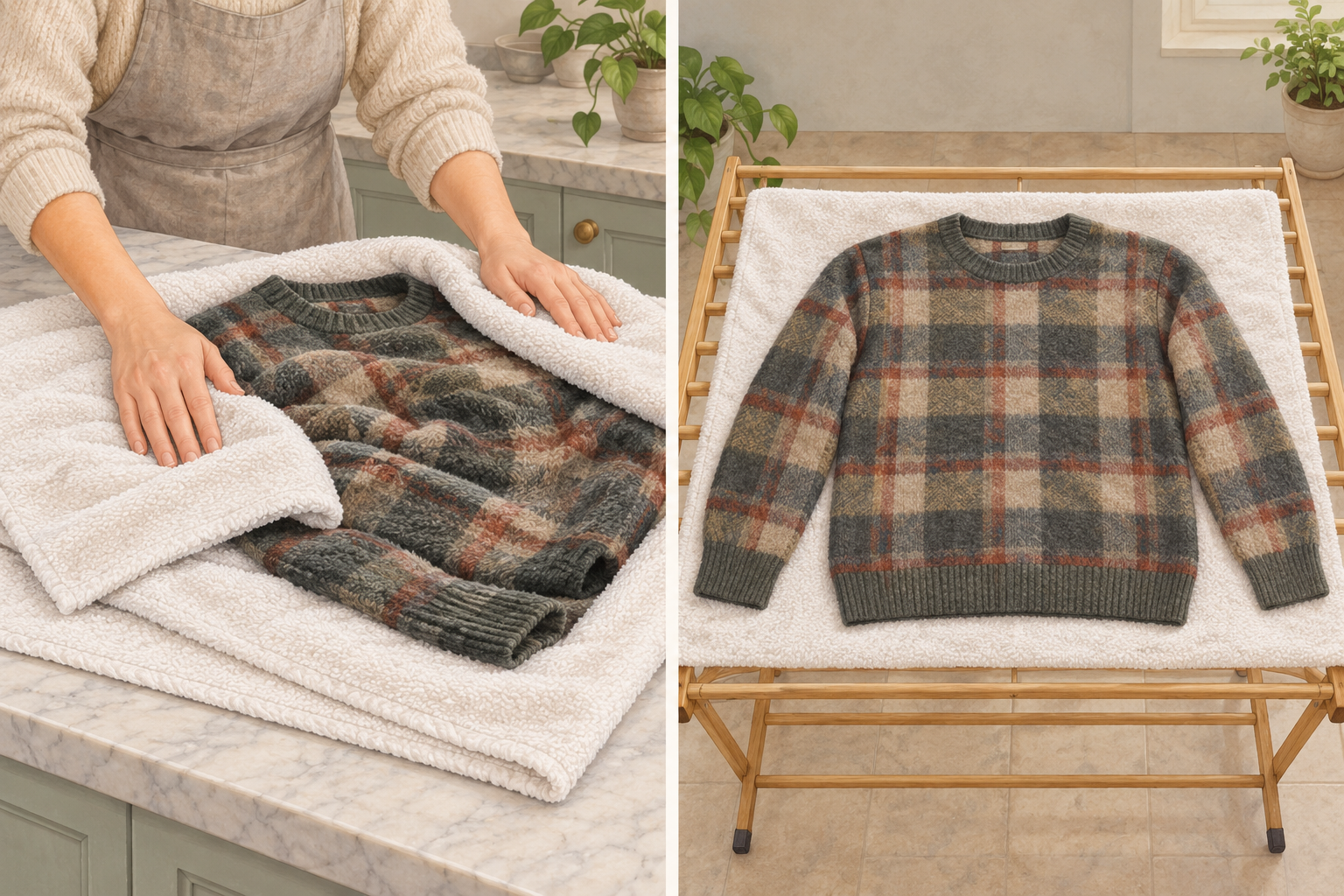
AI illustration: blot gently without wringing, then reshape the sweater and dry it flat.
-
Reshape and let it dry flat
Arrange the sweater on a pale, lint-free towel over a flat drying surface. Gently bring the sleeves, hem and body back to their usual shape without tugging. Smooth out folds. Keep it away from radiators, direct sunshine and other direct heat; do not hang it by the shoulders or over a line.
If the towel becomes wet, replace it with a dry one while supporting the garment. Wait until the entire sweater is dry before folding it away. A thick knit may need a day or longer; use dryness, not a countdown, as your finish check.
Troubleshooting
- Still soapy: rinse again with clean water rather than adding more products.
- Drying slowly: use a fresh towel and a well-ventilated flat spot, not stronger heat.
- Stretched shape: gently reshape while damp. Do not pull hard to force a fit.
- Dense, shrunken fabric: severe felting is not reliably reversible. Do not expect a conditioner soak to undo it; ask a knitwear-care specialist before further treatment.
Frequently asked questions
Can I use the washing machine instead?
Only if the garment label permits machine washing, using its stated cycle and temperature. A machine hand-wash setting is not automatic permission to ignore a hand-wash-only label.
Can I use ordinary detergent?
Use a product specifically suitable for wool and check its directions. Avoid enzyme-containing detergent and bleach; a gentle-looking bottle is not enough to establish suitability.
Does every plaid sweater need this method?
No. Plaid is a pattern, not a fibre. Cotton, acrylic, wool blends and embellished garments can have different instructions. Check each sweater separately.
Why this topic, and what the trend does not prove
Checked October 23, 2026: Pinterest Trends, region United States, displayed “Plaid Sweater Styles” with Pin saves up 10,001% versus last month. The overview chart covered July 27–October 19, 2026; Pinterest did not expose exact month-comparison boundaries in this public view. The detail curve had dropped from its recent peak and edged back up, so this is not a claim of uninterrupted acceleration. It measures saves of style content, not searches for washing, product sales or overall demand. The practical care guide is an editorial response to that style interest, not a claim that sweater washing itself is trending.
Sources and related care
This is a research-based guide, not a hands-on detergent test. Care instructions were checked against Woolmark’s care-label guide, wool washing instructions, detergent guidance, flat-drying guidance, and WoolOvers’ towel-press method.
For another material-specific routine, see how to clean suede UGG boots without soaking them. Do not apply this sweater-washing method to suede footwear.