
To tie a four-in-hand knot, wrap the wide end around the narrow end, bring it up through the neck opening, then feed it down behind the front band. Tighten gently and check the length before lowering your collar.
Allow about 10 minutes of active practice for a first attempt, including one or two retries. This is an editorial estimate, not a timed test. Use a tie you already own; no special tool or purchase is needed.
The hero and length-comparison images are AI-generated generic illustrations, not photographs of a tested product. Follow the written sequence for the knot.
Before you start
Stand at a mirror with room to move your hands. The right and left directions below refer to your own body, not the side of the mirror. Work with the wide blade; the narrow tail stays mostly still. Keep the tie comfortably loose while practicing, and loosen it immediately if it presses on your neck.
What you need
- A standard necktie you already own
- A collared shirt
- An eye-level mirror
Steps
-
Set the starting length
Raise your collar and drape the tie with its finished face outward. Put the wide end on your right, about 12 inches below the narrow end as a starting point. Your height and the tie’s thickness affect the final length, so treat this as a first try rather than a measurement you must keep.
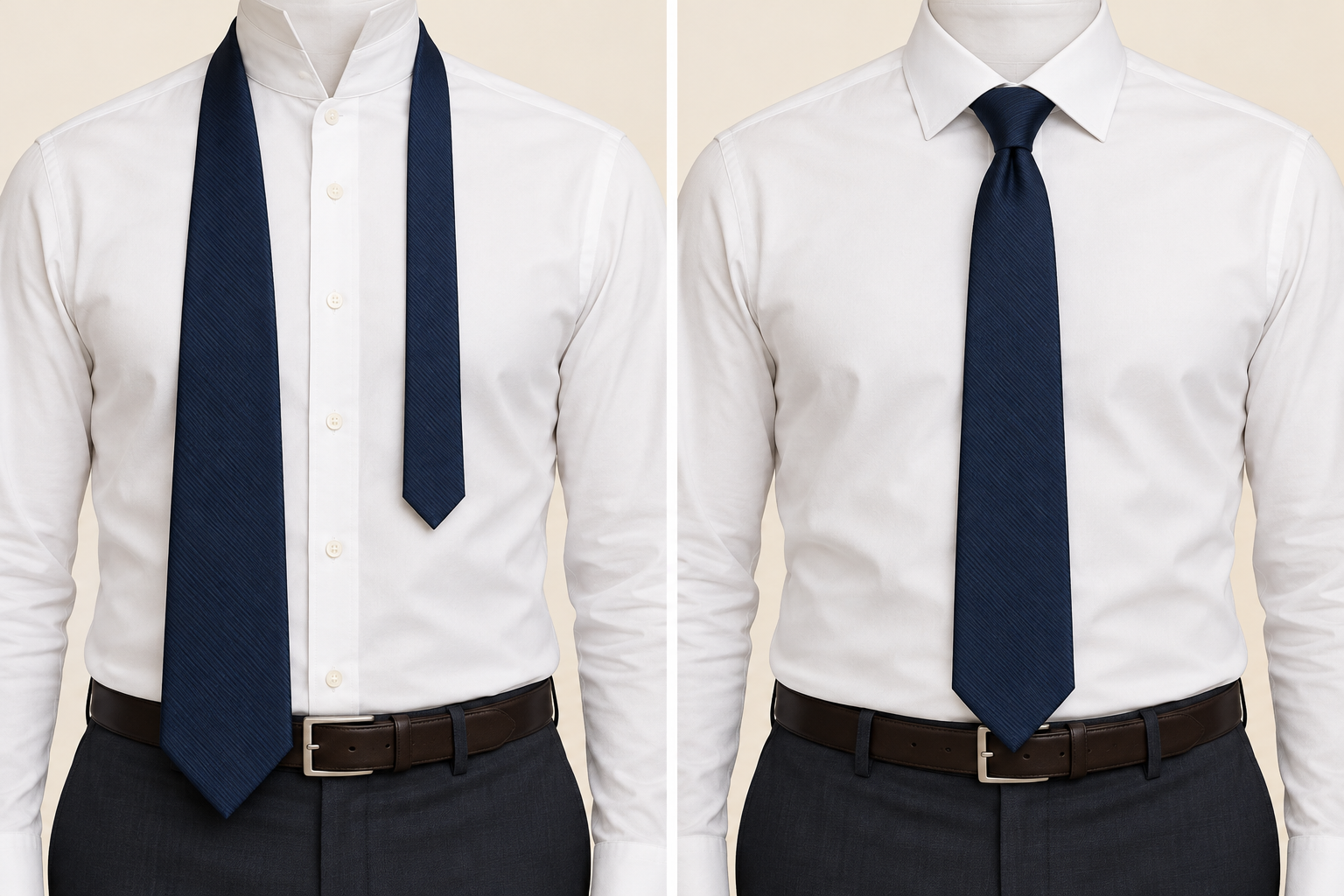
AI-generated generic illustration: unequal starting ends at left; the finished length target at right. The starting difference varies with the wearer and tie.
-
Cross over, then pass behind
Carry the wide end across the front of the narrow end toward your left. Hold their crossing lightly. Bring the wide end behind the narrow end and back toward your right. Keep the fabric flat instead of twisting it into a rope.
-
Make the front band
Move the wide end across the front once more, from your right to your left. This creates the smooth band on the face of the knot. Keep a finger behind that band so you can find the opening later. Do not pull it tight yet.
-
Go up through the neck opening
Lift the wide end from underneath through the large opening between the tie and your neck. Bring it out above the loose knot. This is the neck opening, not the small band at the front. Keep holding the front band open for the next movement.
-
Feed down through the front band
Point the wide tip downward and pass it behind the front band you held open. Pull the blade through slowly while supporting the knot. A small pinch in the fabric just below the knot can form a dimple; it is optional. Stop and loosen the band if the fabric bunches or catches.
-
Adjust the knot and check the length
Hold the narrow tail and slide the knot up gently until it sits comfortably at the collar. Lower the collar. Aim for the wide tip to reach the belt buckle; a small sideways lean in a four-in-hand knot is normal.
Quick fixes and common questions
- The tie is too short: undo it and begin with more length on the wide side.
- The tie is too long: restart with a little less length on the wide side. Change one thing at a time.
- The knot is bulky or twisted: loosen it, flatten the fabric, and repeat the wrap slowly.
- Which loop takes the tip? Up through the large neck opening first, then down through the small front band.
- Must the knot be perfectly symmetrical? No. A four-in-hand naturally has a slight asymmetry.
Sources and why this topic
Instructions cross-checked on October 18, 2026 against Charles Tyrwhitt’s four-in-hand guide and Ties.com’s step-by-step knot guide. For another view of the motions, see Brooks Brothers’ official demonstration.
Topic selection: on October 18, 2026, Google Trends Explore showed “how to tie a tie” at +8% in Rising queries related to “how to,” using United States, Web Search and Past week. This is modest related-query growth, not a claim that the parent term grew 8% or that this is a viral spike. The rolling results can change.