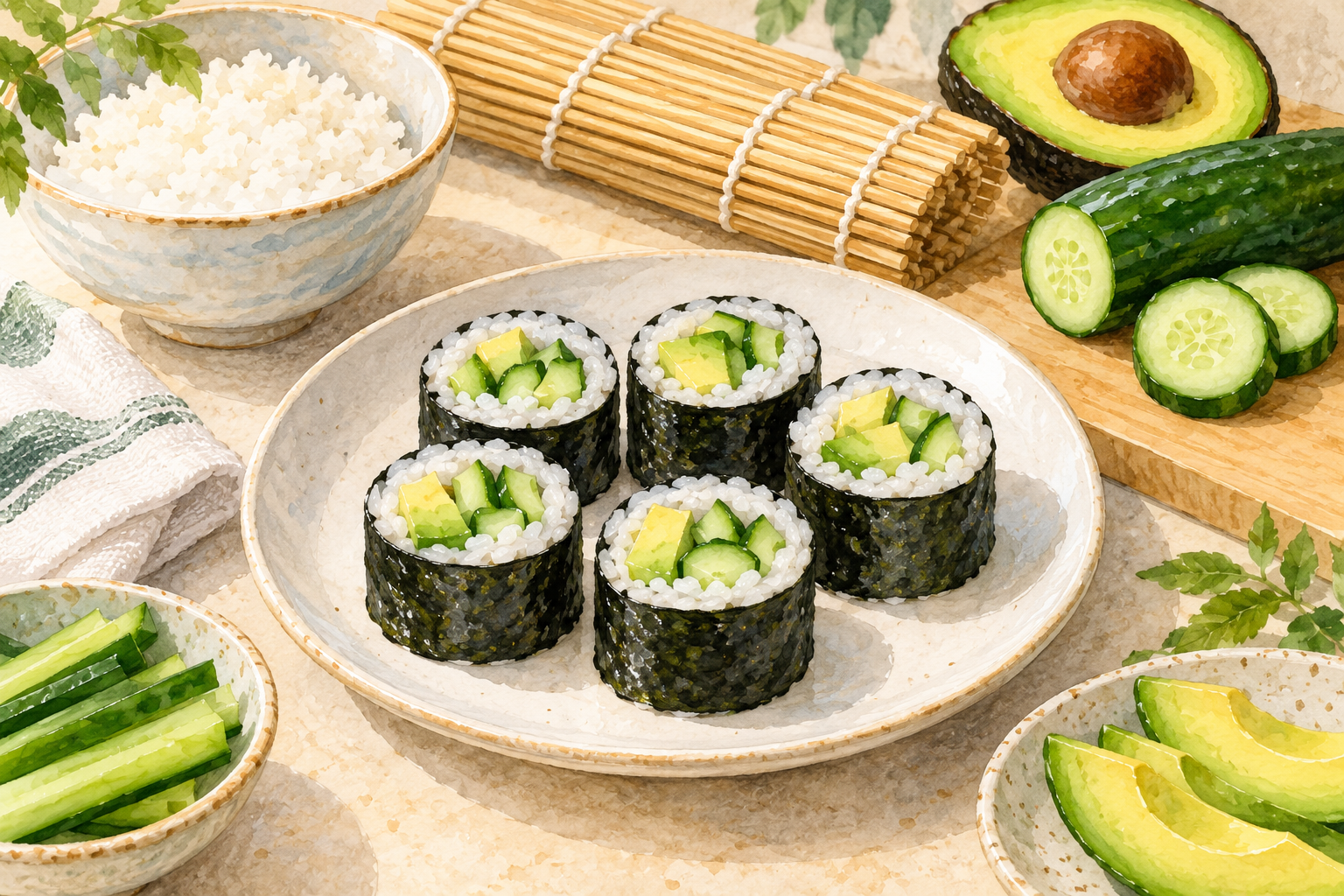
To make sushi at home, spread a thin layer of seasoned short-grain rice on nori, add a modest line of cucumber and avocado, then use a bamboo mat to roll and seal it. Keeping the filling small matters more than making the first roll look perfect.
This beginner method makes about 3 full-size rolls, cut into roughly 18 pieces. It uses no raw fish. Allow about 40 minutes of active work and 60–75 minutes overall, depending on your rice package and cooling time. These are planning estimates, not measured test results.
Rice safety comes first: cooked rice needs prompt cooling and refrigeration even when the filling is entirely vegetables. The vinegar here is seasoning, not a validated preservation method. Make the rolls close to serving time and follow the storage limits in the final step.
Hero image: AI-generated illustration of cucumber-and-avocado sushi; not a photograph of a tested recipe.
If you are building kitchen confidence, our first sheet cake from a box tutorial is another beginner-friendly project.
What you need
- 180 g uncooked Japanese-style short-grain sushi rice; water as directed on its package
- 2 tablespoons unseasoned rice vinegar
- 1 tablespoon sugar
- 1/2 teaspoon fine salt
- 3 full-size sheets roasted nori (plus a spare if available)
- About 1/2 cucumber and 1 small ripe avocado
- Bamboo sushi rolling mat; optional food-safe plastic wrap to keep the mat clean
- Rice cooker or lidded saucepan, fine sieve, measuring spoons and kitchen scale
- Wide clean bowl or shallow tray, rice paddle or spatula, and small bowl of water
- Clean cutting board, sharp kitchen knife and shallow covered storage container
- Optional soy sauce or tamari for serving; check labels for soy/wheat and other allergens
Steps
-
Cook the rice according to its package
Wash your hands and clean the board, utensils and work surface. Rinse 180 g short-grain rice in a fine sieve if its package calls for rinsing. Use the package water amount and cooking/resting directions for your saucepan or rice cooker. Different rice and appliances need different ratios, so do not guess.
The finished grains should be tender and cling together, not sit in a puddle. While they cook, stir together 2 tablespoons unseasoned rice vinegar, 1 tablespoon sugar and 1/2 teaspoon salt until dissolved. Do not add this mixture before cooking.
-
Season and cool in a shallow layer
Move the hot cooked rice into a wide clean bowl or shallow tray. Sprinkle over the vinegar mixture and gently fold with a rice paddle or spatula, using a cutting-and-turning motion rather than mashing. This is a half-batch adaptation of Kikkoman’s sushi-rice seasoning formula.
Spread the rice out and fan gently to release steam. Use it as soon as it is cool enough to handle and no longer steaming. Do not leave a deep pot of rice on the counter to cool for hours. If you are not ready to roll, cool promptly and refrigerate, ideally within one hour of cooking, in small shallow portions.
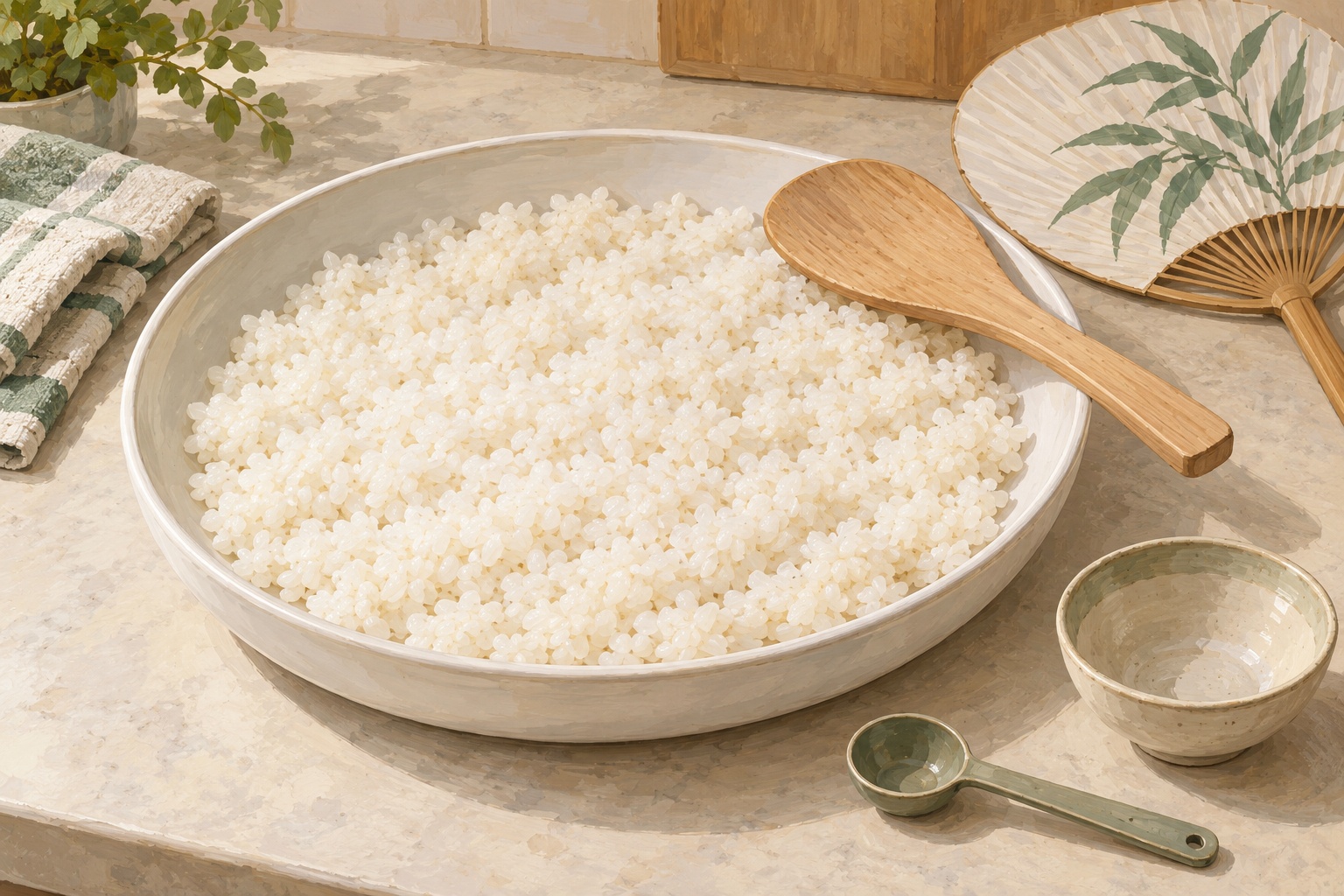
AI-generated illustration: spread the rice in a shallow layer for prompt cooling; do not leave it sitting out for hours.
-
Prepare the vegetables and rolling area
Rinse the cucumber and avocado under running water before cutting. On a stable board, cut the cucumber into slender lengthwise sticks; remove a watery seed center if needed and pat dry. Cut the avocado safely on the board, remove the pit without striking it with a knife, then peel or scoop out the flesh and cut narrow strips.
Set out a small bowl of water for your fingertips. Place a clean bamboo mat with its slats running left to right. Optional food-safe plastic wrap can cover the mat, but it must stay outside the finished roll. Keep unused nori dry until needed.
-
Spread a thin rice layer and add a small filling
Lay one full sheet of nori on the mat, shiny side down and rough side up. Lightly dampen your fingers, then spread about one-third of the rice in a thin even layer. Leave roughly 1–2 cm of bare nori along the far edge to seal the roll. Use less rice if that portion makes a thick mound.
Arrange a modest line of cucumber and avocado across the near third of the rice, parallel to the bare edge. A narrow filling is easier to enclose than a generous handful. Leave room at the sides so the filling does not spill out.

AI-generated illustration: keep the filling in one modest line and leave the far nori edge uncovered for sealing.
-
Roll forward, keeping the mat outside
Lift the near edge of the mat with your thumbs while your fingers hold the filling in place. Bring the near nori edge up and over the filling. Gently snug the first turn without crushing it.
Continue rolling away from you, lifting the mat back as you go so neither bamboo nor plastic wrap becomes trapped inside. Lightly moisten the bare nori edge if needed, finish the roll, and place it seam-side down. Repeat with the remaining sheets, rice and vegetables. A slightly uneven roll still makes a perfectly usable first attempt.
-
Slice, serve and chill leftovers promptly
Transfer each roll to a stable cutting board. With fingers clear of the blade, use a sharp, lightly dampened knife to cut it in half, then cut each half into three pieces. Wipe sticky rice off the blade between cuts instead of pressing harder. Serve promptly with optional soy sauce or tamari.
Do not leave rice or rolls out for more than 2 hours total, or 1 hour when the temperature is above 90°F (32°C). Preparation and serving time both count. For leftovers, use small shallow covered containers in a refrigerator at 40°F (4°C) or below. Following the UK Food Standards Agency’s conservative rice-specific guidance, cool and refrigerate promptly, ideally within 1 hour, and eat within 24 hours. Discard rice or rolls left out too long; smell is not a reliable safety check.
Troubleshooting your first roll
- The nori splits: reduce the rice and filling on the next roll, and use damp rather than dripping-wet fingers.
- The roll will not close: remove a little filling and keep the far sealing strip clear.
- The rice sticks to everything: lightly wet your fingertips and knife; do not soak the nori.
- The slices squash: wipe and dampen the blade, use gentle slicing strokes, and avoid sawing with a blunt knife.
- The roll falls apart: serve the rice, torn nori and vegetables in a bowl instead. Keep the same food-safety limits.
Frequently asked questions
Does sushi have to contain raw fish?
No. This version is seasoned rice, nori and vegetables. Do not add raw seafood using this tutorial; its handling and sourcing need separate guidance.
Can I use ordinary long-grain rice?
Short-grain sushi rice is the more forgiving choice because it holds together. Long-grain rice will not give the same rolling result; a bowl is a better fallback.
What if I only have seasoned rice vinegar?
It already contains seasoning. Follow that product’s sushi-rice directions instead of adding the full sugar and salt amounts above.
Can I make the rolls the night before?
Freshly assembled rolls have better texture; chilled rice can firm up and nori softens. If you prepare ahead, follow the prompt-chilling and 24-hour rice limit above. The vinegar does not make the rice safe at room temperature.
Sources and why this topic was chosen
This is an original, source-checked beginner adaptation, not a claim of hands-on recipe testing. Technique references: Kikkoman’s sushi-rice seasoning method, Kikkoman’s cucumber maki technique, Mizkan’s vegetarian sushi guide, and Kikkoman’s rice, vegetable-preparation and slicing instructions (technique reference only; this tutorial does not use chicken).
Food-safety references: Food Standards Agency rice cooling and storage guidance, FDA time and refrigerator-temperature limits, USDA shallow-container cooling advice, and FDA guidance distinguishing seasoning from controlled rice acidification.
Trend check: checked October 20, 2026, at approximately 10:07 p.m. EDT (October 21, 02:07 UTC). Google Trends, United States, Web Search, past 7 days, listed “how to make sushi” as a +70% rising related query for the search term “how to”. That percentage belongs to the related query, not the parent term. The dedicated sushi-query chart had already passed its October 19 high and was below that peak on October 20, so this is a recent rising-interest topic, not a claim of a current breakout. Relative search interest is not a recipe-quality score. Sources checked October 20–21, 2026.